
The ISTQB certification is a valuable credential for software testers, demonstrating a deep understanding of testing principles and practices.
Preparing for the certification can be a daunting task, and as someone who has experienced this journey, I understand the challenges and uncertainties candidates face. The path to achieving this certification requires a well-structured and efficient preparation strategy. So I decided to share an effective preparation algorithm developed through my experience.
Selection of certification, training materials, and tools
First of all, you need to go to the official ISTQB website and select the certification which is divided into Foundation, Advanced, and Expert levels, and there is also a Specialist group that does not fall under these levels. If you are getting certified for the first time, you should start with the basic Foundation level, after which you will have access to other options.
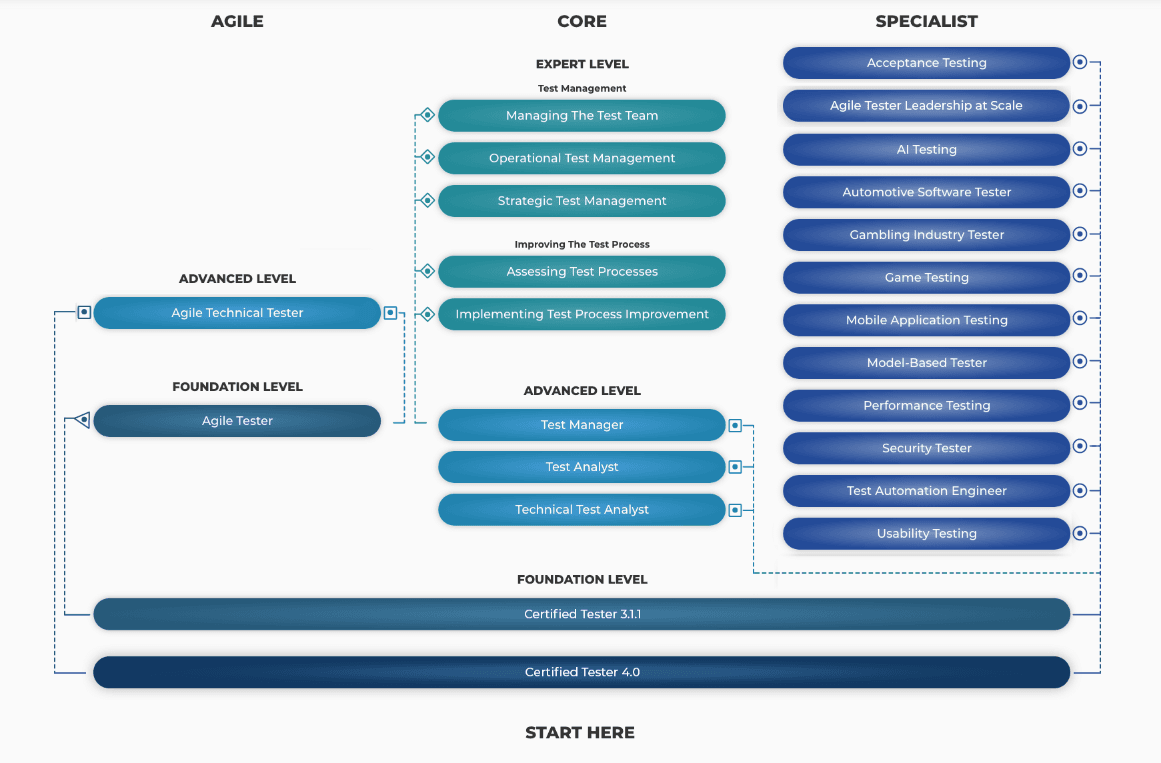
By opening a specific certification page, you can find additional information about it, topics of questions that will be on the exam, and access to downloadable materials.
You will need the following materials for studying:
- Materials that are available in the Download Materials section on the certification page:
- ISTQB Syllabus.
- ISTQB exam examples.
- ISTQB glossary.
- A book that has been designed according to the ISTQB curriculum, covering all the learning objectives of the program, with additional reference material, questions, and tests. For example, for the Certified Tester Foundation Level certification, you can find a book written by the authors of the syllabus: “Foundations of Software Testing: ISTQB Certification (Dorothy Graham, Eric van Venendal, Rex Black)”.
There is a lot of information to work with when preparing for the exam, and the following tools will help you do it efficiently:
- Google Sheets — this tool will help you to plan and organize your work effectively, monitor your progress, and make adjustments. It also allows you to access your plan from different devices with internet access.
- Mind maps are a visual tool used to organize information in a hierarchical and associative manner that helps us structure our study material, enhancing both comprehension and retention. There are plenty of tools for mind maps creation, I used WiseMapping during my preparation.
Mind maps are a very powerful tool that has the following benefits:
- Visual Organization of Information — present information in a visually appealing and structured format, making it easier to understand and remember.
- Enhanced Memory Retention — the use of colors, images, and spatial arrangements in mind maps engages different parts of the brain, leading to better memory retention.
- Improved Understanding of Concepts — creating mind maps forces you to process information actively, which leads to a deeper understanding of the material.
- Flexibility and Adaptability — mind maps are flexible and can be easily updated as you progress in your studies.
- Increased Creativity and Engagement — the process of creating mind maps is inherently creative and engaging. It encourages you to think critically and make connections between different pieces of information.
It’s planning time
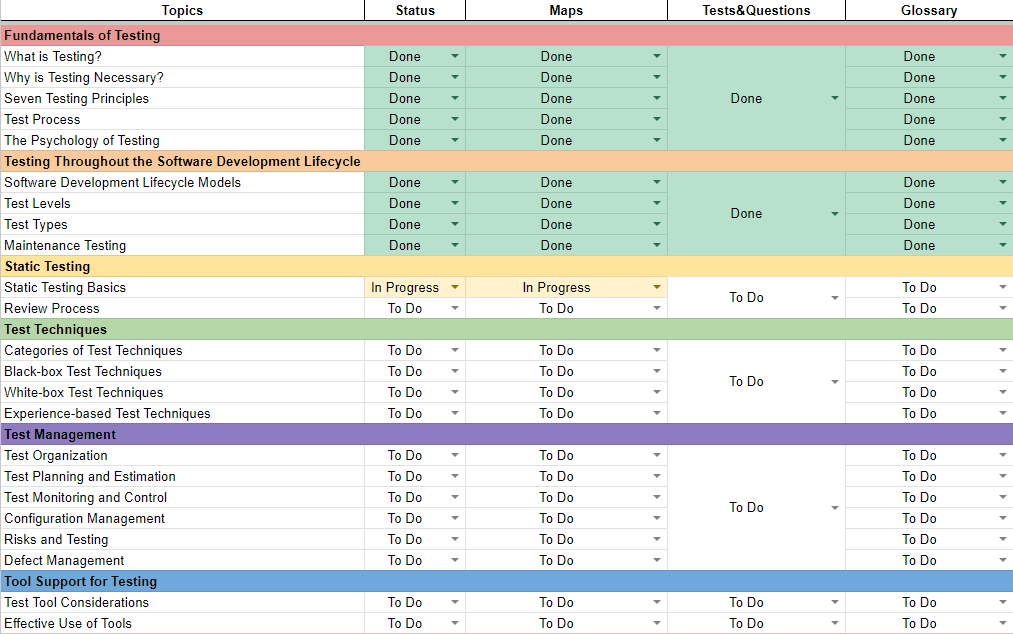
Once you select a certificate, the next step is to create a study plan. I suggest the following structure of the plan:
- Column “Topics”
- Each main section of the syllabus/book will be a separate block.
- Subsections will be the points in our plan that need to be worked out.
- Column “Status” is used to track the progress of studying each section.
- Column “Mind Maps” is used to track the progress of mind map creation for each topic.
- Column “Tests & Questions” — there are questions and tests at the end of each section in the book that should be passed.
- Column “Glossary” — you should additionally allocate time to study the terminology in the glossary for each key term of each topic.
Here is an example of a plan I used to prepare for the Foundation Level certification:
You also need to decide how much time you are ready to allocate for preparation each day. Ideally, this should be at least 2-3 hours a day as there is a lot of material to go through and it is a bad idea to spread it over a long period as you will start to forget the information. In terms of deadline, I would take 3 months, 2 months for the study itself, and a month for revision and preparation for the exam. However, you will need to consider your skills and the time you can devote to it.
Let’s start training
There is a subsection in the syllabus called “Examinable Learning Objectives” where you can familiarize yourself with the levels of learning objectives, and the exam questions will be based on these levels. Also, in the syllabus and the book, each topic is labeled with the appropriate level, which will give you an understanding of what to focus on.
Depending on the certification there are the following levels of learning objectives and questions that you can find in this subsection:
- K1 = Remember: You should remember or recognize a term or a concept.
- K2 = Understand: You should select an explanation for a statement related to the question topic.
- K3 = Apply: You should select the correct application of a concept or technique and apply it to a given context.
- K4 = Analyze: You can separate information related to a procedure or technique into its constituent parts for better understanding and can distinguish between facts and inferences.
- K5 = Evaluate: You may make judgments based on criteria and standards. It detects inconsistencies or fallacies within a process or product, determines whether a process or product has internal consistency, and detects the effectiveness of a procedure as it is being implemented.
- K6 = Create: You put elements together to form a coherent or functional whole. A typical application is to reorganize elements into a new pattern or structure, devise a procedure for accomplishing some task, or invent a product.
Once your plan is ready, you can start with the first topic by reading the syllabus, and then move on to the same topic in the book, as it is covered much more broadly and with more examples which will increase your understanding. You should also pay attention to the key terms and concepts that may be indicated in the introduction or at the end of the chapter.
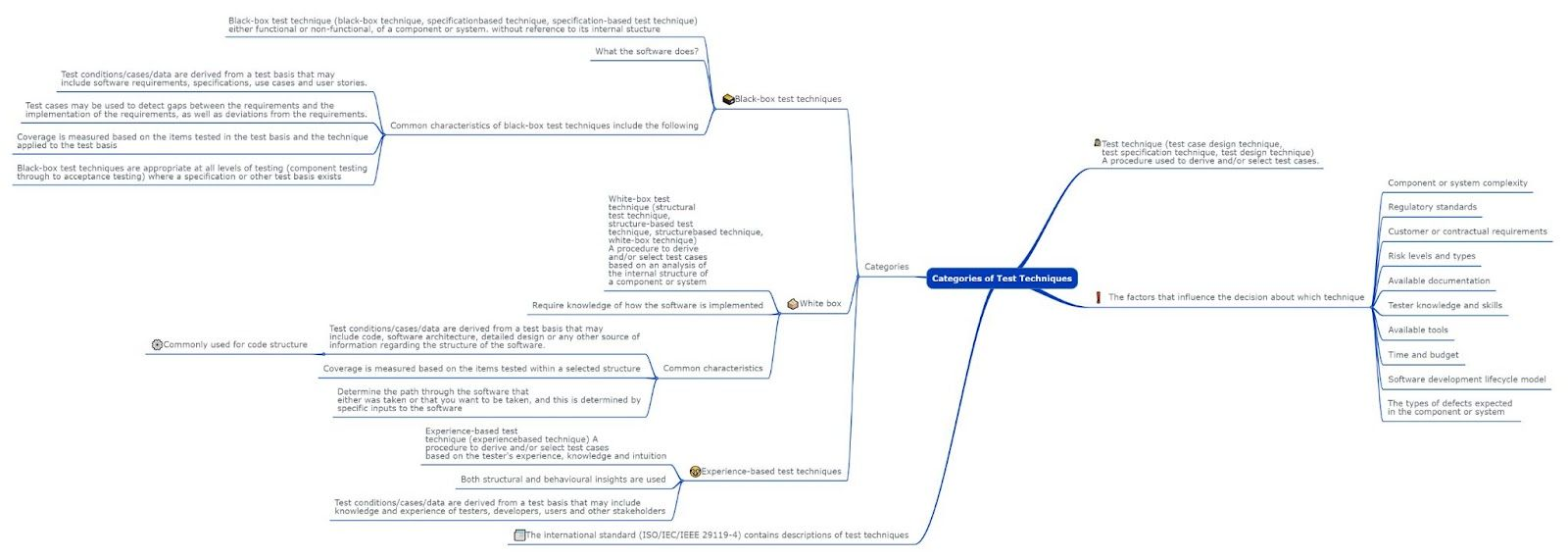
For each of the covered topics, you are required to make a mind map, which will contribute to better learning of the material, as additional analysis will be conducted to identify key points and connections that you will build in your map.
Here is an example of a mind map that was created during my preparation for the Foundation Level certification:
The book contains a set of questions and tests at the end of each chapter that you will need to answer. It is important not to be lazy and spend time analyzing the questions, your answers, and solutions to the practical exercises that you may encounter. The main thing here is not just to choose the right answer or do the practical part correctly, but to have an understanding of your actions and decisions, and analyze your mistakes to find the gaps in the knowledge.
After working with the questions and tests, let’s go through the key terms of the section in the glossary. Note that the exam often contains questions about the term’s definition, and by learning them you will have an easier time finding the right answer because they can be tricky in wording.
In this cycle, you will continue studying until you finish the syllabus and the book. At the end, you will take your first mock exam, which can be downloaded from the ISTQB website, and is also available in the certification preparation book.
When practicing with a mock exam, you should allocate as much time as will be given on the real exam, and if you are taking it in a non-native language, you can add +25% to the exam time. This is the test run, so don’t be upset if you don’t manage to answer all the questions and if you get some answers wrong.
One of the main tasks of the mock exam is to familiarize yourself with the type of questions that will be met on the real exam and their analysis, answers analysis, and the identification of gaps in understanding.
The second task is to build a strategy for passing the exam by analyzing the following questions: Why did you not have time to answer certain questions? Why did you select the wrong answer? Which questions to give priority to, and for which you will return later? For answering the last question you need to understand that you do not need to answer all the questions in the order of the exam because some of them will require time to think or you will simply have some doubts, and the longer you focus on them, the less time will remain for other questions that may be easier and faster to complete.
Repetition of the material you have learned
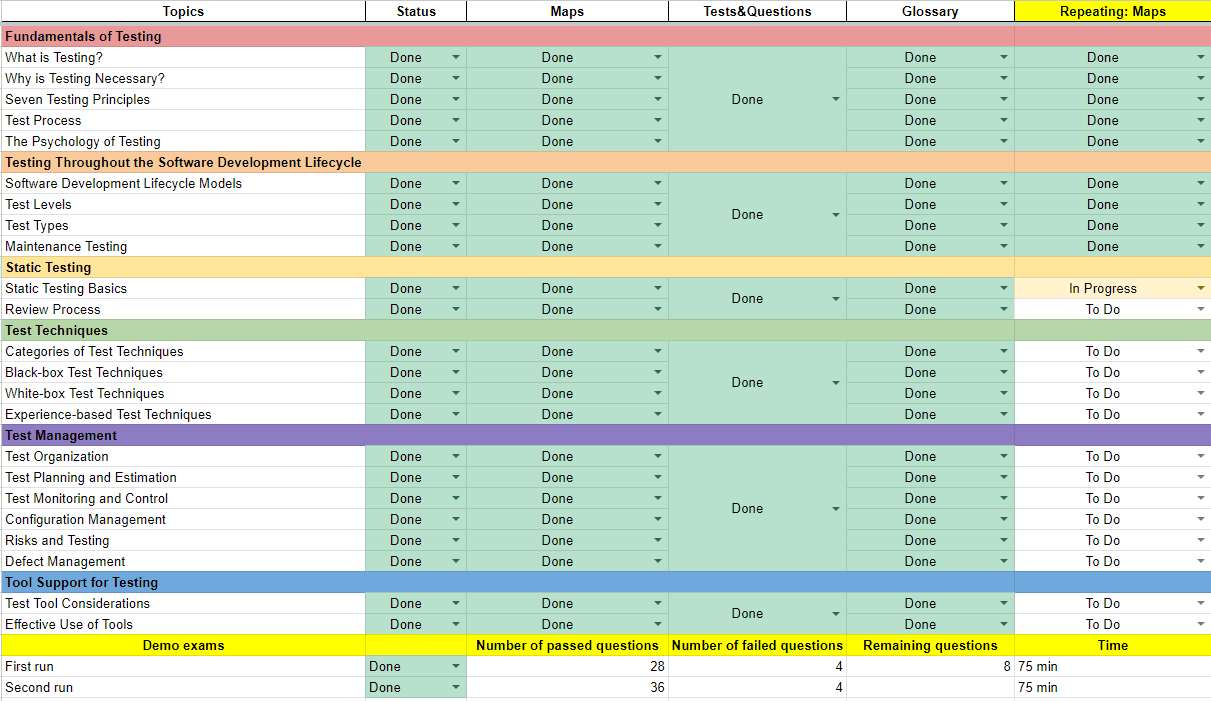
Now it’s time to review the material you have studied to get ready for the real exam. I recommend the following plan:
- Go through topic by topic reviewing your mind maps and repeating glossary terms.
- Take additional mock exams that can be found on the Internet, both paid and free. Carefully read the questions and answer options, as some of them will be insidiously worded to deliberately confuse you if you are inattentive. Postpone the questions that require more time for later, first of all, answer what you are sure of and can quickly complete, and then return to more difficult questions. To speed up the selection of answers, you can use the method of elimination, where we reject wrong options, thereby narrowing the circle to the correct answer. You will also encounter situations where several options seem correct, and you will need to analyze them carefully and eliminate the unnecessary. There may be situations when, in your opinion, none of the options is fully correct, and here you can choose the one that is closest to the correct answer.
- Be sure to add columns for reviewing activities into your plan for progress monitoring.
And what to do when you are done repeating?
- Register for the exam.
- Repeat the maps and glossary terms to keep your knowledge up to date.
- Pass the exam and celebrate =)
That’s it!
I hope this article will be useful and help you with your exam preparation!
Good luck and have some fun on this journey =)